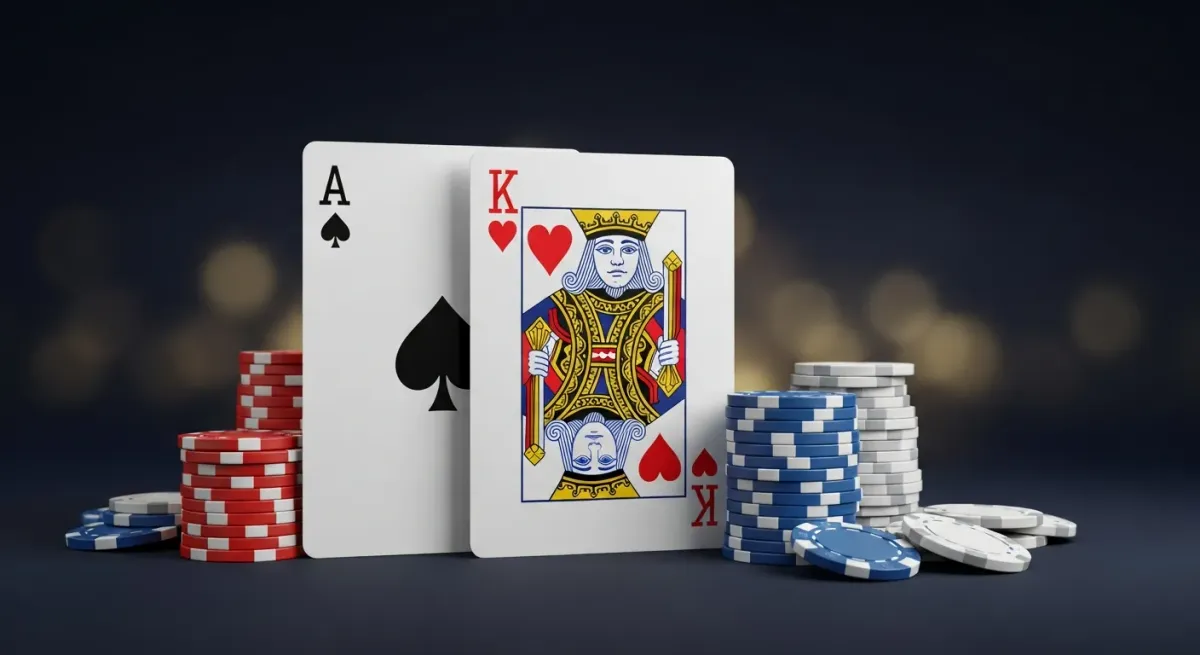
Blackjack is the best bet in the casino for players who are willing to learn a little. Played correctly, it has one of the lowest house edges of any game — under 1% — which means more of your money stays in play and a good session can last all night. Played on autopilot, it quietly hands the house 2–3%. The gap between those two outcomes is entirely skill, and this guide covers everything you need to close it.
We'll walk through the rules, the moves available to you, the basic strategy that cuts the house edge to the bone, the payout detail that separates good tables from bad ones, and how online blackjack differs from the live-dealer version. It's an informational guide, not financial advice.
The Goal (It's Not "Get to 21")
The single most common misunderstanding about blackjack is the goal. You are not trying to get to 21. You are trying to beat the dealer — either by having a higher total than them without going over 21, or by the dealer going bust while you're still standing.
Card values are simple: number cards are worth their face value, all face cards (J, Q, K) are worth 10, and an Ace is worth 1 or 11, whichever helps you more. A "blackjack" — an Ace plus any ten-value card on your first two cards — is the best hand in the game.
Here's the flow of a hand:
- You place a bet, then you and the dealer each get two cards. One of the dealer's cards is face-up.
- You act on your hand first, choosing from the moves below.
- If you go over 21, you "bust" and lose immediately — this is the house's built-in advantage, because you act first.
- Once you're done, the dealer reveals their hidden card and draws according to fixed rules — typically drawing until they reach 17 or more.
- Whoever is closer to 21 without busting wins.
Your Five Moves
Everything you do at the table is one of these five decisions:
-
Hit — take another card. You do this when your total is low enough that busting is unlikely or impossible.
-
Stand — take no more cards and end your turn.
-
Double down — double your bet in exchange for exactly one more card. Powerful when you're in a strong spot, like a total of 11.
-
Split — if your first two cards are a pair, split them into two separate hands with a second matching bet.
-
Surrender — where offered, fold your hand and reclaim half your bet. Useful on genuinely bad hands like 16 against a dealer's 10.
Basic Strategy: The Chart That Cuts the House Edge
Basic strategy is the mathematically optimal move for every possible combination of your hand and the dealer's up-card. It isn't a betting system or a way to "beat" the game — it's simply the play that loses the least over time, and it's what drops the house edge from 2–3% down toward 0.5%. Serious players keep a full strategy chart open while they play online; there's nothing stopping you.
Here's the core of it, simplified to the decisions that matter most:
| Your hand | Dealer shows 2–6 | Dealer shows 7–Ace |
|---|---|---|
| 8 or less | Hit | Hit |
| 9 | Double (else hit) | Hit |
| 10 or 11 | Double | Hit if dealer beats your total |
| 12–16 (hard) | Stand | Hit |
| 17 or more (hard) | Stand | Stand |
| Ace + 6 or less (soft) | Hit / Double | Hit |
| A-A or 8-8 | Always split | Always split |
| 10-10 or 5-5 | Never split | Never split |
The logic behind the most important row: when the dealer shows a 2 through 6, they're weak — those are the cards most likely to make them bust. So you play conservatively, standing on stiff totals of 12–16 and letting the dealer take the risk of drawing. When the dealer shows a 7 through Ace, they're strong, so you have to be braver and hit those same totals. Master that one pattern and you've captured most of basic strategy's value.
The Payout Detail That Matters Most: 3:2 vs. 6:5
Before you sit at any blackjack table, online or live, check one thing: what it pays for a blackjack. The traditional, fair payout is 3:2 — a $10 blackjack pays $15. Some lower-quality tables quietly pay 6:5, where that same $10 blackjack pays only $12.
That change sounds small. It isn't. A 6:5 payout adds roughly 1.5% to the house edge — more than tripling the edge you worked so hard to minimize with perfect strategy. There is never a good reason to play a 6:5 table when 3:2 games are available. If a table pays 6:5, walk. This is the biggest single mistake recreational blackjack players make, and it's completely avoidable.
While you're checking payouts, also avoid the side bets (Perfect Pairs, 21+3, insurance). They're tempting and they pay big occasionally, but their house edge dwarfs the main game's. Insurance in particular is a sucker bet for anyone who isn't counting cards.
Online Blackjack vs. Live Dealer
Online, you'll meet blackjack in two forms, and the difference matters more than it first appears.
RNG blackjack is software: a random number generator deals the cards, and the deck is effectively reshuffled after every hand. It's fast, cheap to play (low minimums), and available instantly. It's also completely uncountable — because the shoe never depletes, there's no information to track.
Live dealer blackjack streams a real human dealer handling physical cards from a real shoe. It's slower and more social, feels more transparent because you watch every card land, and — for the tiny minority of players who count — is the only online format where counting is even theoretically possible, and only when the shoe has decent penetration before shuffling. For help vetting any casino before you sit down, see our guide to choosing an online casino.
For almost everyone, the choice comes down to feel: RNG for speed and low stakes, live dealer for atmosphere. The odds on a well-made 3:2 game are similar either way.
A Word on Card Counting
Yes, card counting is real, and no, it isn't illegal — it's just tracking the ratio of high to low cards left in the shoe. But it's largely irrelevant online. RNG games reshuffle every hand, and many live tables now use continuous shuffling machines specifically to defeat counters. Unless you're playing a live table with a hand-shuffled shoe and deep penetration, counting won't help you. Treat blackjack as a game you play well with basic strategy, not one you beat — and be wary of any "system" promising more, which is exactly the trap we dismantle in our piece on why the Martingale strategy doesn't work.
Bankroll and Game Selection
Because blackjack is low-variance compared with high-volatility slots, a modest bankroll goes a long way — you'll see far fewer wild swings than on a jackpot pokie. If you want to understand why some games swing harder than others, our high vs. low volatility guide explains the maths. Set a session budget, bet a small fraction of it per hand (1–2% is a common rule), and never raise your bet to chase a loss. And pick your casino as carefully as your table — our guide to choosing an online casino covers licensing, payouts, and fair game rules.
FAQ
What's the house edge in online blackjack? Around 2–3% if you play by instinct, but as low as roughly 0.5% if you follow basic strategy on a 3:2 table with player-friendly rules. Blackjack rewards skill more than almost any other casino game.
Is 3:2 or 6:5 better? 3:2, always. A 6:5 payout adds about 1.5% to the house edge — a huge penalty. Never play a 6:5 table if a 3:2 one is available.
Can I count cards at an online casino? Practically, no. RNG blackjack reshuffles every hand, and many live tables use continuous shufflers. Counting only works at a live table dealing from a physical shoe with good penetration, which is rare online.
Should I take insurance? No. Insurance is a side bet with a high house edge and a losing proposition for anyone who isn't card counting. Decline it.
Is live dealer blackjack better than the software version? Neither is "better" — they offer similar odds on a fair 3:2 game. Live dealer feels more transparent and social; RNG is faster and cheaper to play. Choose by preference.
Responsible gambling: You must be of legal gambling age where you live — 18 in Australia and in Alberta, Manitoba, and Quebec, and 19 in most other Canadian provinces. Blackjack is entertainment, not an income; play within a set budget and never chase losses. If gambling is becoming a problem, free confidential help is available in Canada through ConnexOntario at 1-866-531-2600, and in Australia through Gambling Help Online at 1800 858 858. Know your limits, and play within them.